Wednesday, December 3, 2025

KiwiRail Downsizes Its Fleet At Expense Of Growth


When KiwiRail was first formed in 2008 there was much excitement at what was to come.  With some 40 million tonnes of New Zealand's annual 300 million tonne freight task being suited to rail, there was an opportunity with government investment to more than double the pre-existing 18 million tonnes being carried on rail at the time.

Fast forward 17 years to 2025 and KiwiRail is carrying less than ever at around 15 million tonnes per year.  Yards around the country are filled with hundreds of surplus wagons and as reported extensively in South African media on November 2nd 2025, KiwiRail have decided to sell off a quarter of their locomotive and rolling stock fleet to a company in South Africa who will lease them to private operators as part of South Africa's ambitious plan to increase rail freight volumes from 160 million tonnes per year to 250 million tonnes.

The difference between New Zealand and South Africa's approach to rail freight is stark.  New Zealand is going full steam backwards whilst South Africa powers forward.  South Africa has a specified goal of 250 million tonnes, up from 160 million tonnes.  KiwiRail has no stated goal, and never has.

Politicians have poured billions into network upgrades but have never required the company to grow volumes in return.  And so they haven't.  Down from 18 million tonnes in 2008 to just 15 million tonnes in 2025.

In New Zealand we maintain an inefficient state owned monopoly and protect it from competition.  In South Africa the network has been opened up to competition and multiple new companies have lined up to operate trains competing with the state operator.

It's ironic that KiwiRail is doing more to grow rail freight volumes in South Africa than it is at home.

The New Zealand public have been told that the rationale for investing in KiwiRail is to achieve mode shift from road to rail, delivering environmental, economic and social benefits.  Since KiwiRail is carrying less, not more, after 17 years of intense investment to the tune of some $10 billion, we can conclude that the benefits have not eventuated and the rationale for investing in KiwiRail has failed.

At the heart of this failure is the lack of competition on the New Zealand railway network.  KiwiRail has a very specific business plan that targets only a small number of large customers.  They are primarily a logistics partner for the ports working with New Zealand's biggest exporters, with a small domestic freight component between Auckland and Christchurch.

Two former KiwiRail locomotives now in service in Namibia.  KiwiRail have already sold more than a dozen of their serviceable locomotives to African operators and are set to sell another 46 locomotives in 2026 and likely more thereafter, prioritizing growth in Africa at the expense of growth in New Zealand


KiwiRail has divested itself of all other customers over the past 17 years, usually by way of increasing their contract rates by as much as 300%, ensuring the customer leaves and switches to road transport.

KiwiRail's chosen niche market is essentially fully captured.  There is little to no scope for increasing their customer base.  Essentially KiwiRail's freight volumes will only go up or down according to the fortunes of their existing customers.  This is why we see negative growth in KiwiRail.

If New Zealand is to grow rail freight volumes then it requires a competitive and innovative rail industry in which other players can add their own business strategies to the bigger picture.  With some 25 million tonnes of rail-suited freight on offer there is plenty of opportunity for growth, especially with smaller customers who may only fill one or two wagons at a time, which KiwiRail has priced off the market but where other operators will price competitively.  

Whilst KiwiRail may only offer a rate competitive with trucking if the customer loads 30 wagons, another operator may be willing to price competitively with trucking for a single wagon load, but aim to have 30 customers.  Same end result, but with many more currently unrealized customers coming onboard under the latter scenario.  There is also a multitude of legacy issues with KiwiRail that add to the inefficiency of the company that other players won't have.

One of the major impediments to new companies starting rail operations is the establishment costs.  However, with KiwiRail currently presiding over some 60 soon-to-be-surplus locomotives and at least 920 surplus wagons (likely more), now is the opportune time for the government to make the same bold decision the South African government has made, and make the following changes:

  • Open up the New Zealand rail network to competition, setting a goal of eventually increasing freight volumes on rail from 15 million tonnes to 40 million tonnes, bringing in private capital in addition to any remaining government investment.

  • Transfer ownership of KiwiRail's 60 surplus locomotives and 920 surplus wagons to the New Zealand Railways Corporation (NZRC), who currently manage KiwiRail's land requirements.

  • Allow NZRC to lease locomotives and rolling stock to new entrants who wish to establish operations on the New Zealand rail network. 

Australia went through a similar process in the late 1990s, and that resulted in a more than doubling of interstate rail freight volumes.  The UK and parts of Europe had similar results, with the UK alone experiencing 66% growth after private operators were allowed to do business.

South Africa's plans are very ambitious, but there's no shortage of new companies coming on stream, with at least seven buying up locomotives and rolling stock from wherever they can get them, ready to commence operations.

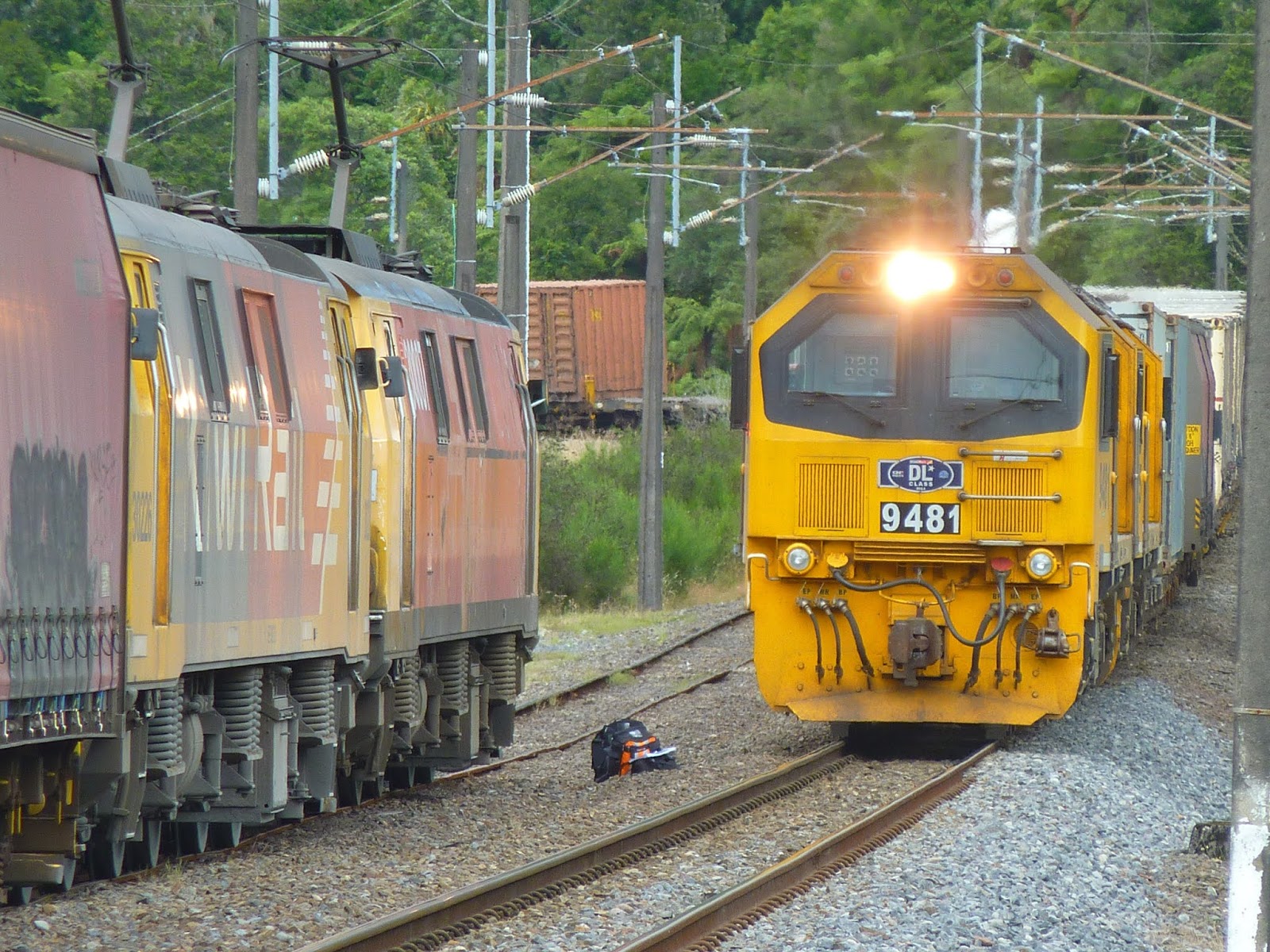
There's no reason New Zealand can't do the same, albeit on a smaller scale.  With so many surplus locomotives and wagons currently available, now is the time to act.  

Monday, February 3, 2020

Rail network planning & funding changes: Making a submission


There are four days left for indviduals and organisations to make a submission on the proposed changes to the planning and funding framework for New Zealand's national rail network - all submissions must be received by 5pm Friday 7th February 2020.

Notable changes proposed include:

  • Abolishing KiwiRail's existing track access fees for other operators. 
  • Setting new track user charges for all operators, set and regulated in a transparent way by government, with each operator paying the charges into the National Land Transport Fund rather than to KiwiRail. 
  • Establishing a new three-year Rail Network Investment Plan (RNIP) with input from local councils and subject to public consultation.
     
These are important changes that will give New Zealanders a greater say in how the network should be developed over time. It also takes us much closer to enabling network access by other operators for moving freight, by separating track access charges from KiwiRail's business.

Submissions can be made here


A further cabinet paper will be released in due course, dealing specifically with the setting of network user charges, and that too will be open to submissions.


Monday, March 11, 2019

A look at KiwiRail's new regional commuter train

The Trains


As a part of the planning for the proposed new Hamilton to Papakura commuter train that was approved by Waikato Regional Council last year, and due to commence running in March 2020, new carriage design concepts were developed by Auckland-based Barnacle Design Ltd.  These have consequently been chosen by stakeholders in the proposal, and have been taken forward to the construction stage by KiwiRail.


Four basic concepts were designed, then considered by stakeholders, all based on former SA and SD class carriages made redundant in 2015 by Auckland Transport.  These included:
  • Refurbished SA carriage with 54 seats
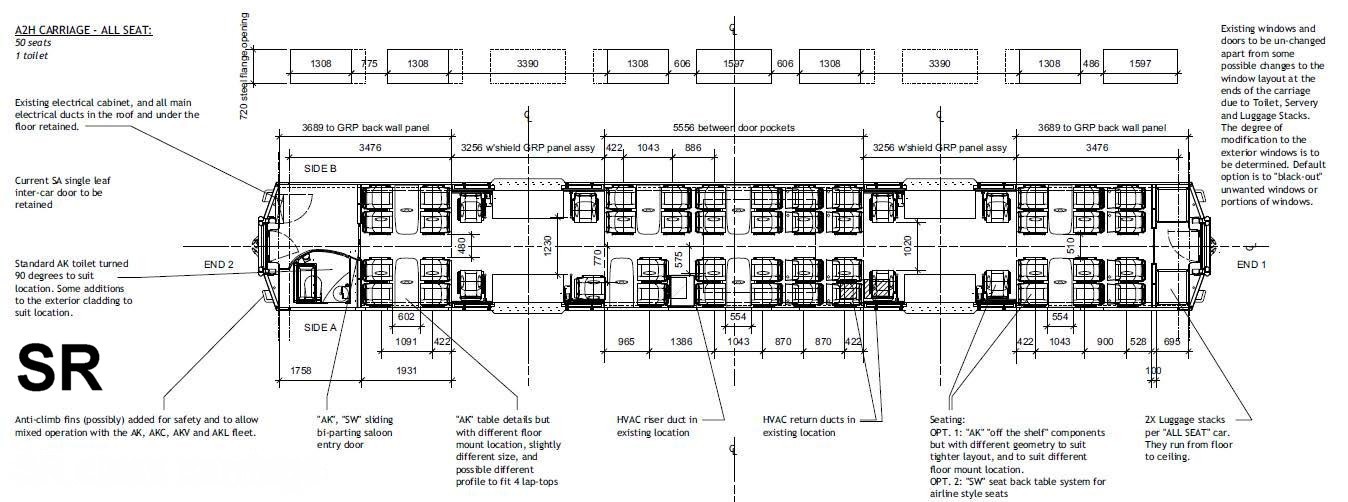
  • Refurbished SA carriage with 50 seats and toilet
  • Refurbished SA carriage with 20 seats, severy and toilet
  • Refurbished SD carriage with 28 seats, space for bicycles, generator room, staff compartment and driving cab
Other combinations were also designed early on, including a refurbished SD carriage with severy that focussed on wheelchair accessibility, but reduced the number of regular seats to just three.  But it was the four above mentioned designs that went through to final consideration, and of these, the second, third and fourth designs listed above were recommended.  The 54 seat version was not taken further as it was recognised that international best practice is to provide one toilet for approximately every 50 passengers.

These three carriage designs have subsequently been classified by KiwiRail as classes SR (seating), SRC (seating plus severy) and SRV (seating, genset and driving cab).


The R in the new SRx classification series stands for Regional, and marks the beginning of a new variety of carriage, designed for longer distance service, but retaining the metro-style doors.  This results in slightly fewer seats being available as opposed to traditional quarter doors as used on existing regional carriages from Wellington to Masterton and Palmerston North.  But the cost and complexity of conversion was considered prohibitive, and the metro-style doors presently fitted are relatively modern and fully functional as is.  They also make it easier to board with bicycles and make more of the train accessible to wheelchair users.


One disappointment for me is the lack of ribbon windows as fitted to the SW series used between Wellington and Masterton.  Those panoramic windows really enhance the travelling experience, and create a very sleak looking carriage profile.  But I gather that may have been difficult to acheive with retention of the metro-style doors, which interupt the monocoque chassis design of the former British MkII carriages.  You can only modify such a structure so far before it weakens, without substantional further modifications. And that costs.


And an example of a typical cross-section of an SR class carriage:


13 carriages (ten SA and three SD) have been purchased, of which 11 will be refurbished, leaving two SA carriages stored unrefurbished.  Of the 11 to be refurbished, there will be 5 x SR, 3 x SRC and 3 x SRV. 

In normal service there will be two consists of 2 x SR, 1 x SRC and 1 x SRV.  The other three refurbished carriages will be one spare of each class. 

A new servicing depot will be constructed at Te Rapa, and all refurbished carriages will be serviced there.  All the carriages to be refurbished are now at Hutt Workshops, having been moved from storage in Taumarunui in 2018 and early 2019.  Work began on their refurbishment in February 2019.

The Stations


The trains will serve four stations in total, being Frankton and Rotokauri in Hamilton at the south end of the journey, Huntly along the way, and Papakura at the north end of the journey.  This is somewhat disappointing when you consider the substantial population growth taking place in Te Kauwhata, Pokeno and Tuakau, but also Ngaruawahia and Pukekohe (for alighting northbound and boarding southbound) have potential. 

Whilst the passenger service is between Hamilton and Papakura, the trains themselves will run between Hamilton and Otahuhu, where they will access the stabling sidings at Westfield during the day.  The plan is to extend the passenger service to Puhinui from 2022, once the new interchange with airport buses is completed.  It is further planned to extend the passenger service to the Strand from 2024, but only if the third main project has advanced enough to enable this by then.

Starting from the south, the first station is Hamilton (Frankton) station, and minimal work is required here as the existing station building and shelter are to be used.

At Rotokauri, a whole new station needs to be built, and this will be in the form of a central platform between the two mainlines, one of which will be slewed west to create the space necessary.  Pedestrian access will be via a level crossing with cages, although this may yet be changed to an overbridge design, if not from day 1 then at a later date as usage increases.  Such overbridges are far from cheap, as they need to be wheelchair accessible and this may in turn necessitate the need for elevators.  It may be a good idea to leave that consideration until such time as the service is considered permanent, and not a trial.  An overbridge would however be an opportunity to also provide a direct pedestrian link with the shopping mall on the eastern side of the tracks, which isn't currently planned to be linked.

The new Rotokauri station, with park 'n ride

At Huntly, the existing station which hasn't been used since the Overlander last ran is to be reopened after an upgrade that involves a new or heavily reconstructed platform, new shelter, basic chip seal park'n ride, upgraded siding and signals, and resurfaced pedestrian overbridge linking the station to the town centre over the railway lines and state highway 1.

The upgraded Huntly station and proposed park 'n ride site

The Huntly station is unusually located on a siding rather than on either of the mainlines.  It was previously a central platform between the mainlines slightly further south of its present location, but that was demolished and the tracks straightened in the late 1990s.  The new, very basic station, was then provided on the siding, and was last used by the Overlander.  This slows trains down a bit, as they need to pass through the turnouts at each end of the siding, and travel at yard speed within the siding. For northbound trains, they need to crossover the southbound track to access the siding.  It's not ideal, but I do note that the original central platform design further south could potentially be reinstated one day if usage justifies it. The straightening or widening of state highway 1 here never eventuated, and is unlikely to ever do so now that the Huntly bypass is nearing completion.

Papakura station does not require any work for the service.

Other stations were considered for the service, but ruled out, though I understand consideration is being given to extending the scope of the proposed Pukekohe electrification to include Tuakau or Pokeno.  Both locations are undergoing substantial growth but their usage has been deemed more suited to frequent services, which has oddly increased their chance of being added to the metro network but worked against them being included in the Hamilton train project.
Concept design for Tuakau station, although this is not being proceeded with at this time

The Timetable


The Hamilton-Papakura service is to operate as two morning trains from Hamilton to Westfield on weekday mornings (no passengers north of Papakura), two from Westfield to Hamilton on weekday evenings, one from Hamilton to Westfield on Saturday mornings, and one from Westfield to Hamilton on Saturday afternoons.  A Sunday service is expected to commence in year four (assuming a successful three year trial), but has been held off for now to allow for Sunday track shutdowns associated with the proposed third main project.  The indicative weekday timetable:


The Locomotives


Three DFB locomotives overhauled for the proposed trains, which I understand to be 7077, 7295 and 7335, have been allocated to the service.  The cost of these three overhauls, amounting to $8m, has been fully allocated to the establishment budget of the service.  They will be used in freight and long distance passenger service until the Hamilton train commences.  The normal plan will be to have two in service and the third held as a spare, on any given day.

The SD-to-SRV carriage conversion includes retention of the driving cab controls, and through-train locomotive control system, so it will be possible to drive the trains from either end.  If not on the long distance run, then for the positioning moves at each end of the journey.

Saturday, May 28, 2016

New Zealand's newest multi-million dollar rail facility set to open

New Zealand's newest multi-million dollar rail facility, Midland Port, is set to open next week.  The rail link is primarily to move containers 30km between Lyttelton and Rolleston, specifically to get trucks off the streets of Christchurch, but will also be used to move containers to and from points south and west.

A contracted rail freight service between Rolleston and Lyttelton will offer a daily dedicated 24-wagon rail shuttle for customers.


In my opinion this would not be a viable project for KiwiRail.  But for a company like LPC, willing to add in external benefits such as traffic congestion reductions, time savings and environmental and safety benefits to the cost analysis, the numbers stack up. 

It's a great example of why the rail industry needs more and more players to drive things forward. Innovation is about thought process as much as it is technology.


Click here to view video 

The railway construction project contract was awarded by LPC to Fulton Hogan, with tamping work sub-contracted by Fulton Hogan to KiwiRail.

The new Jones Road level crossing on the new link into Midland Port (Gerald Petrie photo)

Thursday, October 22, 2015

DBM Engineering's freight train

Quite neat to see a non-KiwiRail "freight train", operating under an independent licence, on the national network.  With thanks to Alex Burgess, who filmed the move.


DBM own quite a collection of locomotives and rolling stock, which until now have been based at their Otahuhu depot, but are in need of relocation due to proposed development of the depot site for a new freight forwarding depot.

With thanks to Alex Burgess, who filmed the move.

Monday, October 19, 2015

Gisborne rail service viable and essential

(reproduced from "Hawke's Bay Today", 20th October 2015 edition)


Talking Point – Rail Service Viable and Essential
By Alan Dick - 

 “The immediate challenge however is how to handle the “wall of wood” from the Wairoa forest” 

In your article “Nash talks up re-opening of rail link” (Monday, October 19), MP Craig Foss, as a determined opponent of rail, is quoted: “The evidence was that the line was hardly being used before the washout.” He added: “Businesses were choosing not to use the line and had been choosing not to for many years.” He is wrong. 

In fact, in the immediate period leading up to the washouts, three or more fully loaded trains were moving squash and other products from Gisborne to Napier Port – and demand was such that double the number of trains could have been running except that KiwiRail could not provide the required locos, wagons and drivers. 

What had happened? From 2010, all Hawke’s Bay and East Coast MP’s, with the exception of minister Foss, had been urging businesses to use rail. Correctly sensing demand, KiwiRail spent $300,000 to lower the bed of three tunnels, to finally enable full capacity 40ft high-cube containers to be carried on the line.

Brand new high-cube curtainsider wagons, for palletised traffic, in Gisborne in 2012

Then entrepreneurial Gisborne-based transport operator Steve Weatherell (running 80 trucks nationally) took the opportunity as a freight forwarder to shift his customers’ product from road to rail. 

For his customers, a smooth, damage-free ride for their sensitive product and direct movement of full containers from packhouse to portside without repacking or double handling. 

For Weatherell Transport, better service for their customers and avoiding a difficult road. For Hawke’s Bay and Gisborne, dual transport mode choice, reduced heavy traffic congestion on a difficult route, and consequently safety and environmental benefits. 


Weatherell Transport tripled tonnage on the Gisborne railway in early 2012, demonstrating how effective other operators can be at securing freight contracts for the rail network

What a tragedy when the washouts struck in March, 2012. Avoidable with proper attention to culvert and drainage maintenance, had the line remained intact KiwiRail would have now had a fully viable rail business with all the resultant environmental and economic benefits for our region. 
 
High-cube containers enroute from Napier to Gisborne, 2012

That takes us to today. 

The Gisborne container freight market potential remains and, in fact, will grow with a wood processing hub to be established. 

Gisborne Port is a specialised log exporter but is unlikely to ever attract export container ship calls. Napier is the logical container destination, being closer than Tauranga. 

The immediate challenge, however, is how to handle the “wall of wood” from the Wairoa forest harvests, which will ramp up dramatically over the next few years. Not including logs, which will continue to move by road to processors like Pan Pac, Wairoa export log harvests will move from 323,000 tonnes next year to a million tonnes and more from 2020. 

Forest managers believe that conservatively half of that volume can, and should, move by rail from a log hub at Wairoa to Napier Port. there will still be plenty of work for truckers, moving logs on short trips from the harvest sites to the log hub and carrying extra volumes direct to the port.

High-cube containers being transferred from road to rail in Gisborne. Rail is the only transport mode able to move these fully loaded from Gisborne to Napier, and without it, growth of the local economy is hampered

There is a viable business for a rail operator on the East Coast line, based initially just on Wairoa logs alone but with heritage steam tourism and Gisborne container potential. KiwiRail have at least two such proposals on their desk. 
 
New Zealand's newest shortline operator, the Gisborne City Vintage Railway, is set to commence operations between Gisborne Port and Muriwai from November 2015

And the worst case outcome? KiwiRail rejects the rail freight proposals in favour of a lease to cycle or golf cart tourism promoters.
The then consequence of State Highway 2 having to handle quadrupled log volumes will be heavy traffic congestion from a road transport industry with insufficient capacity to cope, the road being wrecked, tragic deaths and injuries from accidents, and game-changing opportunity for the economic and social development of northern Hawke’s Bay lost forever. It can’t be allowed to happen. 

High-cube containers travelling south from Gisborne by rail, 2012

* Alan Dick is a Hawke’s Bay regional councillor, former Napier mayor and is chairman of the Hawke’s Bay regional transport committee. 

(All photos courtesy Napier-Gisborne Railway Ltd)

Monday, September 28, 2015

CentreRail ramps up Castlecliff rail operation

As part of Wellington-based CentrePort's lower North Island growth strategy, a second weekday train service from Castlecliff (Wanganui) to Wellington was introduced on Monday 28th September 2015.

The first run of new train 565 on Monday 28th September. Photo by Brad Harvey


Until Friday 25th September, Castlecliff was served by train 560 from Palmerston North each weekday morning, and train 561 back to Palmerston North each weekday afternoon.

The new timetable has new service 566 arriving from Wellington in the morning, returning to Wellington in the afternoon as train 565, and a rescheduled 560 arriving from Palmerston North in the afternoon, returning as new service 567 to Wellington in the evening.  Trains 560 and 565 are scheduled to cross at East Town.

The weekend 562-569 service continues as before, operating as required.

CentrePort has made rail the backbone of its central New Zealand growth strategy, operating and trading as CentreRail, linking hubs in New Plymouth, Castlecliff, Palmerston North and Blenheim, with CentrePort in Wellington, targeting forestry and dairy products in particular.

CentreRail uses dedicated trains between Castlecliff and Wellington, but also makes use of scheduled KiwiRail services for tonnage from New Plymouth and Blenheim.


Sunday, July 13, 2014

NZ First rail policy announced: Railways of National Importance

Below is the New Zealand First rail policy, released on Sunday by Winston Peters at a press conference in Gisborne:


RAILWAYS OF NATIONAL IMPORTANCE

  • New Zealand First will ensure that none of New Zealand’s railway lines and other strategic railways infrastructure will be privatised, and will remain under state control and ownership to ensure that public service rather than commercial objectives is the paramount consideration.
  • New Zealand First’s vision includes passenger train services along all rail routes between the main centres, with connecting coach services linking outlying areas or running services between centres which don't have a railway line. These services would provide a mixture of accommodation standards and fares to make rail services more affordable for New Zealanders to use e.g. half the carriages to be high standard premium fare similar to that provided on current KiwiRail tourist focussed trains such as the Northern Explorer and Tranz Alpine services, and the other half of the carriages being basic, affordable economy fare intercity market, e.g. railcars would have one premium carriage and one economy carriage. The Silver Fern railcars, former Overlander carriages and Silver Star carriages could be appropriately refurbished and upgraded locally in railway workshops to operate daytime regional Intercity services. Fast modern railcars and new carriages, New Zealand built where possible, could later be purchased for certain routes.
  • As a state-owned enterprise, KiwiRail is currently heavily constrained because it is required to pay for the maintenance, renewal and upgrade of rail infrastructure through the revenue generated from its freight and other businesses.
  • New Zealand’s rail network is a national asset that must be developed to optimise its long term role in support of New Zealand’s economy and of an efficient and cost effective multi-modal and well integrated transport system.
  • New Zealand First will develop a programme of railways of national importance (RONI) to ensure that better use of our railway network and services are achieved, with improvements and extensions where there is opportunity to significantly reduce dependence on the roading network, especially for heavy freight and bulk freight services, but also where passenger services can be redeveloped to attract sufficient demand over time.
  • To this end New Zealand First will not require the whole cost of development of new railway tracks and services, and of electric reticulation, to be met by revenue generated by railway service charges; and these will instead be met in whole or in part by a combination of Land Transport Fund funding and crown grants.
  • The Land Transport Fund funding will be achieved by reallocating funding from the current RONS $12 billion plus programme. An initial budget of $400 million would be created by reprioritising Roads of National Significance (RONS) projects that have low or marginal benefits.
  • The rail routes listed below would form the basis of the core transport network between the main centres with daily passenger and freight services, and with the tracks being upgraded or new lines built as required, together with new transport interchanges between trains and buses, and freight hubs in all the main centres:

- Auckland-Whangarei-Opua
- Auckland-Pokeno-Paeroa-Te Aroha-Tauranga-Whakatane
- Auckland-Hamilton-Tokoroa-Rotorua-Taupo
- Auckland-Wellington
- Wellington-New Plymouth
- Wellington-Gisborne (via the Wairarapa line)
 -Nelson-Blenheim
 -Christchurch-Greymouth
- Picton-Christchurch-Dunedin-Invercargill.


Napier-Gisborne Railway (James White photo)

  • The following are the proposed RONI projects to be considered in the long – medium term, subject to detailed cost and benefit analysis to confirm their value:

1. North Auckland  and Marsden Point Line

Northland needs good rail connections to the rest of New Zealand if it is to grow. That means upgrading the Auckland to Whangarei line. Good rail links to Northland means developing a rail link from the main line to Marsden Point port, which has great advantages as a deepwater harbour that does not require dredging. There is also plenty of land for expansion.  There is great scope for it to serve as a container port and take pressure off Auckland and Tauranga. The potential of the Port of Northland for the region, as well as for the country as a whole, is being strangled by lack of an effective rail link.

2. Rolling Electrification Programme

New Zealand First proposes an on-going rail electrification programme to use the skills and expertise built up in the current Auckland suburban rail electrification project. The first project will be to extend electrification from Papakura to Pukekohe. Other potential projects to be investigated include electrification between Auckland and Hamilton, Hamilton and Tauranga, and extending electrification north from Waikanae and from Upper Hutt to Masterton. Many other projects for electrification would follow in later years:

- Lyttelton-Christchurch-Greymouth.
- Christchurch suburban area.
- Picton-Christchurch-Dunedin-Invercargill.

3. Regional Opportunities

Funds will be made available for smaller capital investment opportunities that KiwiRail is unable to fund given its current funding constraints.

In particular, $4m will be used reinstate the Napier –Gisborne line as soon as possible.

4. Cook Strait Ferries

The Cook Strait Ferry service and vessels will be funded for upgrades to ensure a high quality fast reliable and safe service for freight and passengers.

5. Auckland-Pokeno-Paeroa-Te Aroha-Tauranga-Whakatane

A new line to be built along the rail formation between Pokeno-Paeroa-Te Aroha, a new line to be built between Te Aroha and the western portal of the Kaimai tunnel and a new line to be built between Awakeri and Whakatane, all combined creating a shorter and more direct rail route into the Bay of Plenty.

6. Auckland-Hamilton-Tokoroa-Rotorua-Taupo

A new line to be built between Kinleith-Rotorua-Taupo primarily for forestry traffic, as well as for general freight and passengers.

7. Nelson-Blenheim

A new line to be built between Blenheim and Nelson, completing this long proposed project for freight and passengers.         

8. Auckland International Airport

A new line to be built to link the Auckland International Airport with the rail system. The proposed new integrated terminal at Auckland (like that built at Christchurch International Airport) is already being designed to accommodate a rail terminal within the building.

9. Auckland City Rail Link

Build the Auckland City Rail Link tunnel project under central Auckland as soon as possible, jointly funded with the Auckland Council.

10. Northland

New lines to be built to link the rail system with ports in Northland between Oakleigh and Northport at Marsden Point, and Otiria and Opua in the Bay of Islands.

11. New suburban services

New suburban passenger train services will be investigated for Christchurch, Dunedin, Tauranga and between Hamilton and Auckland.

This includes an initial investigation into establishing suburban passenger train services in Christchurch, Dunedin, Tauranga and between Hamilton and Auckland using Auckland’s surplus diesel rolling stock immediately following the introduction of electric services in Auckland.

12. Rail siding grant scheme

New Zealand First will introduce a grant scheme to encourage greater use of rail transport by industry and by distribution centres, where the cost of installing or re-commissioning rail sidings will be met 50/50 by the businesses using the rail siding and the New Zealand Railways Corporation.


New Railways structure proposed by NZ First

KiwiRail would be restructured by splitting it into three new  organisations:

1. New Zealand Railways Corporation - owning and managing rail land, tracks and infrastructure, stations and rail-freight centres, shunting yards, workshops, train control systems, managing and maintaining the rail network, allocating access to the rail network for rail operating companies, setting rail training standards and qualifications, and acting as the rail regulator and licence agency.

2. Kiwi Rail - operating rail passenger services between all main centres, and operating the Interisland ferries.

3. Rail Freight – a new State Owned Enterprise operating a commercial rail freight business.

Sunday, May 4, 2014

Gisborne railway reopening proposal: Public submissions close 12th May

Long time rail supporter Cran Julian has made the following request, for all with an interest, to show their support to the Hawke's Bay Regional Council for reinstatement of the Napier to Gisborne railway.  Please make sure your voice is heard, as we must fight to save this railway line.  It is very important that the council has public support in order to be able to proceed with its proposal.
______________________________________________________

It would be appreciated if all those interested in saving the Napier Gisborne Railway through the establishment of a regional shortline venture with the Hawke’s Bay Regional Council as well as other investors please make sure you write submission letters of support to the Hawke’s Bay Regional Council before the deadline closure of 12 May for submissions to the Council’s Draft Annual Plan for 2014-15.

Given the Minister of Transport Gerry Brownlee’s recently stated position in Parliament and media of (to date) not planning to put any Government funding into repairing the line to a “good fit for purpose” operation condition, the Council needs to hear from people who think that the region now needs to fund the repairs as well as have the Council lease the line from KiwiRail, and have a regionally based company with private sector investors and partners operate and maintain it.

As your help is needed to support the initiative of the Napier-Gisborne Railway Establishment Group and the Hawke’s Bay Regional Council in their endeavours to re-open the line as a shortline freight operation for the benefit of Northern Hawke’s Bay/Gisborne/East Coast region and the country as a whole.

This railway line is particularly important to handle the increasing amount of container freight and other produce to/from Gisborne and the increasing wall of wood already starting to be harvested in the Wairoa-Gisborne areas. As well as this, it will also enable the return of excursion trains beyond Napier to a line which is very picturesque and offers unparalleled views ‘up their’ with best scenery in NZ.  And as we all know – the greatest tourist attraction on East Coast is in fact the Napier-Gisborne rail link itself.

There are those that do not want to see this line re-opened, notably amongst them the bike trail lobby, who are exerting pressure on KiwiRail and the Government almost daily to take over the line for a bike trail.

It is time for all rail supporters to stand up and be counted or the permanent closure of this line is a VERY REAL possibility.

A 900 metre long freight train in the Esk valley on its way from Napier to Gisborne. This one train removed at least 50 trucks from state highway 2 and local roads, making the roads safer for the public and cheaper to maintain
 
Napier Gisborne Railway – Proposal Details:


HBRC’s ongoing investment strategy is to improve financial, economic and environmental benefits for the whole region by investing in sound regional infrastructure assets. 

One potential infrastructure investment is the re-establishment of the Napier-Gisborne rail line as a viable alternative to the transport of freight by road. HBRC, in conjunction with private sector partners, is considering investing in the operation of a rail business carrying freight on the line. A critical component of any such investment will be the agreement of KiwiRail and the Government to reopen the rail line and for them to fully fund its return and that of associated infrastructure in a good ‘fit for purpose’ condition.
A proposal from the Napier Gisborne Rail Establishment Group (NGR) is summarised as follows. 

  1. Establish and operate a rail freight service between Napier and Gisborne on the existing rail line once it has been returned to full operational status by the Government and KiwiRail.
  2. Lease locomotives and the line from KiwiRail, purchase appropriate rolling stock from KiwiRail, or elsewhere, to operate the service.
  3. Carry freight, which will largely be logs, fruit and vegetable produce.
  4. Anticipate financial losses in the first three years of operation, returning to profit in year 4 and generating significant returns to shareholders as log volumes increase – anticipated in year 6, and HBRC becomes a 51% shareholder in the venture, with businesses and investors in Hawke’s Bay and Gisborne District holding the remaining 49% of shares in the operating company set up for this purpose.

The proposal claims benefits to Hawke’s Bay with social, economic, and employment gains; improved transport infrastructure with price competitiveness and efficiency over road and rail land transport modes; safety and cost benefits through reduced heavy traffic on SH2 between Gisborne and Napier; increased volumes of exports through Napier Port; and the security of an alternative transport route to road in the event of a disaster. 

The NGR Group estimates that investor funding to finance capital and operating budgets will total $10.7million, consisting of: 

  • Purchase of rolling stock, plant, equipment etc $ 5.3m 
  • Working capital $ 2.4m
  • Disaster Contingency Reserve $ 3.0m
      --------------------------------------------
       Total Investor Funds Required $10.7m


A 51% shareholding investment from HBRC would be approximately $5.46m of the Total Investor Funds required over the 2014-15 to 2018-19 financial years. An initial investment of $3.9million would be required from HBRC for the 2014-15 year.

Any investment by HBRC in the NGR would be conditional on:

  • The Government and/or KiwiRail fully funding the return of the rail line and associated infrastructure to a "good fit for purpose" operating condition.
  • Leases of the line and locomotives from KiwiRail on terms satisfactory to NGR.
  • Suitable offtake agreements being concluded between NGR and customers for the freighting of logs and fruit and vegetable produce over the period up to and beyond 2020 to ensure the long term viability of the service.
  • NGR’s business case being tested and accepted as satisfactory, and the return to HBRC over the long-term is to cover Council’s cost of funding.

HBRC investor funds would initially be sourced from investment reserves, but ultimately would require refinancing from HBRC’s borrowing programme.

We welcome your views on whether or not you consider this to be a good investment for HBRC, and also if the investment does not proceed during 2014-15 whether HBRC should advocate for the line to be kept in a well maintained condition in its mothballed state so that it could be readily re-opened in the future.

Another 900 metre freight train on the Napier to Gisborne railway

Public Submissions:


Submissions to the council by email:

draftplan@hbrc.govt.nz

Submissions to the council by post:

Draft Annual Plan Submission, Freepost 515
Hawke’s Bay Regional Council
Private Bay 6006
Napier 4142.


People from anywhere are welcome to make a submission

Monday, April 7, 2014

Auckland Transport's freight train concerns

In September 2011, KiwiRail made a somewhat surprising announcement in its staff newsletter "Express", that it intended to proceed with construction of a third mainline between Otahuhu and Wiri, and eventually to Papakura.  To quote part of the the report:

Preliminary design work on a third main line to the North Island Main Trunk into Auckland between Otahuhu and Papakura has begun with the expectation that a section between Otahuhu and Wiri will be completed by mid 2013.

 “A third line would have significant benefits for both freight and metro services,” says KiwiRail Network General Manager Rick van Barneveld.

The report continued:

KiwiRail is working on a four-stage project expected to cost between $60 and $70 million dollars. Funding by other parties for some elements are expected to bring the whole project cost to around $100 million.

The announcement was a surprise to many observers at the time, as it was also known publicly that Auckland Transport was not keen to provide any funding for the project, despite the fact that their passenger services would benefit from greater separation of freight trains and suburban passenger trains.  It was this anticipated funding from Auckland Transport that was included in what the KiwiRail report refers to as "other parties".

Perhaps KiwiRail got a bit ahead of themselves by anticipating this funding contribution from Auckland Transport, but during 2012 they commenced work on the third main, constructing the formation between Otahuhu and Mangere, and between Puhinui and Homai.  January 2013 saw track reconfigurations take place at Otahuhu, and track laying commence around Wiri in association with EMU depot track construction.  However, at Wiri only the portions of third main required to provide access to the new depot were constructed.  The bulk of the third main through Wiri itself was not laid.

Third main formation construction through Wiri, January 2013.
As of April 2014, the track has still not been laid.

Third main construction at Puhinui, January 2013.

It became evident in early 2013 that the third main project had stalled because of no agreement being reached between KiwiRail and Auckland Transport around joint funding of the project.  The track was not laid through Wiri station, while the track laid at Puhinui became nothing more than a temporary backshunt for the new EMU depot.  Between Otahuhu and Mangere, the third track was not connected at the south end and has remained out of use ever since, bar a short section at the Otahuhu end, used as another temporary backshunt.

Track to nowhere: The third main at Mangere, with no
funding to complete it.

Jump forward to March 2014, and the division between Auckland Transport and KiwiRail over the third main project has become more evident, through their respective submissions to the Environmental Protection Authority over a plan change request being made by Tainui Group Holdings Ltd and Chedworth Properties Ltd in relation to their proposed industrial park for Ruakura, in Hamilton.

This industrial park is a $3 billion project to be constructed where the East Coast Main Trunk and proposed Hamilton section of the Waikato Expressway intersect, and will include a large rail-served container terminal.  It is expected that initially four freight trains per day will operate between the container terminal and Ports of Auckland, increasing to six each way as capacity at the terminal is reached.

The proposed container terminal at Ruakura.

The developers (Tainui/Chedworth) believe that the existing Auckland network (i.e., without a third main) can accomodate the new services in the short term, particularly if they operate through the Auckland area during the off-peak suburban train hours, but anticipate that the planned third main will enable the proposed future increase in services to be accomodated when they eventuate.

Auckland Transport Submission, 26th March 2014

Auckland Transport has submitted its concerns over the proposal, making several points:
  • The additional freight trains, both short term and long term, may not be able to be accomodated north of Papakura, and that the developers assessment that they can, may be premature.
  • There is no certainty that the additional freight trains will operate outside peak passenger hours.
  • There is no certainty over whether or not the third main will be built, or whether it will provide enough capacity for the Ruakura trains if it is built.
  • Concern that the developer has assumed it will be granted access to the Auckland rail network for its services when there is no such guarantee.

Auckland Transport's submission continues, by pointing out that access to the Auckland rail network is governed by the Auckland Network Access Agreement (ANAA), an 85-year agreement granting access rights to Transdev for services between Huapai and Pukekohe.  Timetables and capacity provision are decided by the Auckland Timetable Committee (ATC) which comprises representatives from Transdev, KiwiRail Freight, KiwiRail Passenger, and Auckland Transport.  The submission points out that decisions by the ATC must be unanimous to take effect.

The insinuation here is that Auckland Transport may not be willing to allow the passage of these additional freight trains.  However, the concerns appear to be based on an assumption by Auckland Transport that the additional freight trains will be operated by a party other than KiwiRail Freight, which is unlikely to be the case.  The proposed services will more than likely be operated by KiwiRail as "hook and pull" services.  Neverthess, it is clear that regardless of who operates the additional freight trains, Auckland Transport may not allow them.

KiwiRail submission, 26th March 2014

The first point made by KiwiRail in its submission is that even without the Ruakura development, there will soon be conflict between freight trains and suburban passenger trains in Auckland.

Of particular note, the submission states:

There is no doubt that the NIMT in the Auckland Network does not have capacity to accommodate the timetabling objectives of the Metro Service provider with its new trains and the freight operator at critical times of the day from 2015.

The submission then outlines a timetable of when third main work must be completed, in order to prevent capacity constraints on the Auckland network, giving a 2015 date for Westfield to Wiri, and approximately ten years later for Wiri to Papakura.  Interestingly, KiwiRail also states that should electrification be extended to Pukekohe, the third main will also need to go to Pukekohe:

In the longer term a third main will need to be built between Wiri and Pukekohe, and that may also require some passing areas, effectively a fourth main in places.

The submission continues:

The immediate solution is the completion of the third main between Westfield and Wiri, plus some reconfiguration in the Westfield and Southdown freight yards. Both ends of the third main are already in place, and the freight yard works will be complete at the end by June 2015. What remains is the 7km in the middle.

Conclusion

Auckland Transport and KiwiRail clearly have shared concerns over capacity constraints within the Auckland suburban network, on the North Island Main Trunk, but it's apparent that two quite different views exist as to what should be done about it.

Auckland Transport appear to favour restricting the passage of freight trains, whilst KiwiRail favour proceeding with construction of the third main, at least between Westfield and Wiri, where conflict will exist from next year even without any additional freight trains.

It is important that the rail network be developed to accomodate growth by all of its users, both freight and passenger.  Auckland Transport will benefit from greater separation of freight and passenger trains once their higher service frequency between Otahuhu and Wiri is implemented during 2015.  Auckland Transport also benefits from increased use of rail for the cartage of freight, as it keeps trucks off Auckland area roads, making them safer for other users and cheaper to maintain, and reducing air pollution for the people of Auckland.

Hopefully the funding issue can be resolved soon.  KiwiRail is already prepared to pay the lion's share.  But Auckland Transport needs to come to the party and provide some of the funding shortfall.  The matter is becoming critical, as there is only about 18 months remaining before capacity constraints cause delays to both passenger and freight trains south of Otahuhu.


Friday, November 15, 2013

More cash for KiwiRail?

One of the main concerns held by interested observers of KiwiRail's Turnaround Plan has been its ability to fund the necessary capital works required of the plan. 

The Turnaround Plan - known as TAP for short - is KiwiRail's long term plan to create a business capable
of standing on its own two feet financially.  It's a ten year plan for the period 2010 to 2020, and is estimated to ultimately cost $3.1b, in the form of government cash injections and reinvestment of income from the business.

Back in 2010, the government initially stated that it would provide three grants of $250 million each over the first three years of the plan (i.e., $750 million total for 2010-2012 inclusive), after which KiwiRail would need to continue funding the task from its own income.

2013/2014 was to be the first "self funding" year, but numerous observers were skepical of whether or not KiwiRail would be in a position to go it totally alone that soon - and with just cause.  The first three cash injections were spent very quickly, on track work, new locomotives, rolling stock and track maintenance machines, new IT systems and an upgrade of the Aratere rail ferry.  Meanwhile, economic conditions and unforseen natural events resulted in income not rising as much as anticipated.

Earlier this year the government surprised many by announcing a fourth cash injection, this time of $94 million, bringing the total to $844 million.  This wasn't a surprise to KiwiRail though, as the additional funding had been sought, and was granted in response to a request for additional funding.

This begged the question, will the government provide any further funding beyond the current financial year?

Information has now come to light that negotiations for further funding have been taking place over the past few months between KiwiRail management and central government officials.  KiwiRail is seeking $203 million, broken down into two payments, of $81 million for the 2014/2015 financial year, and $122 million for the 2015/2016 financial year.  If these sums are agreed to, it will bring the total cash injection amount to $1.046 billion since 2010.

Photo by Steve McElney, courtesy KiwiRail

As to what it will be spent on, it would seem "more of the same" applies.  Beyond the current eight DL locomotives on order from CNR in China, a further ten are planned to be purchased in 2015.  Then there's yet more flat top container wagons planned, including 175 in 2015, and 200 in 2016.  No doubt the continuing network upgrade will feature in this funding as well.